The right greenhouse heater holds your plants above frost all winter without turning the electricity bill into a shock. The choice comes down to two numbers: the glazed area you heat and the temperature you want to keep.
Choosing the right greenhouse heater for your space
What you pay for is the heat escaping through the glass, so output follows glazing area and the temperature difference you want to bridge – not floor space. A single-glazed 8 x 10 ft greenhouse has roughly 25 m² of glazing: frost-free on a −2 °C night needs around 1.5–2 kW, holding 10 °C for tender plants closer to 2.5–3 kW. Polycarbonate or a bubble-wrap lining lowers that.
Picking the right model
Four criteria decide it, and the first two settle most of the choice:
-
Output. 2000 W covers most 6 x 8 to 8 x 10 ft greenhouses kept frost-free. Choose 2800 W for larger or exposed structures and for growing temperatures above 10 °C; cold frames need a few hundred watts.
-
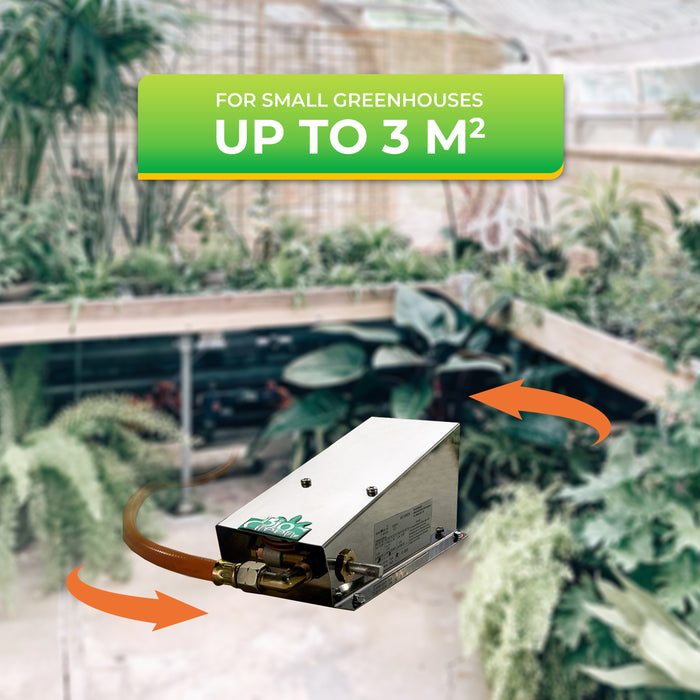
Electric or gas. Electric greenhouse heaters control temperature precisely and add no moisture – the default wherever a weatherproof outdoor supply exists. Gas heaters at 340 W and 800 W need no mains power, which suits an allotment, but they protect against frost rather than hold a set temperature.
-
Thermostat. A manual dial is enough for frost protection. A digital thermostat holds a set point to within about a degree, which is where the savings sit.
-
Fan mode. Moving air breaks up the cold layer at floor level and dries leaf surfaces – the main defence against grey mould in a closed greenhouse.
Set the thermostat to the lowest temperature your plants tolerate. Pelargoniums, fuchsias and citrus overwinter safely at 5–7 °C; raising the target to 10 °C can almost double a season's consumption.
What a greenhouse heater costs to run
Running cost is output × the hours the heater actually runs × your unit rate – not output × 24. A thermostat-controlled 2 kW unit in a lined 8 x 10 ft greenhouse cycles for perhaps a third of a cold night: roughly 12–16 kWh in midwinter, and far less for most of the season. Bubble-wrap lining, curtaining off only the section you are using and siting the heater away from the door cut that bill further than swapping models ever will.
Every fuel-burning heater releases water vapour and carbon dioxide, so gas and paraffin models need a permanent ventilation gap and never belong in an enclosed living space.
Greenhouse heater questions
The points gardeners ask about most:
Do you have to heat a greenhouse in the winter?
Only for plants that cannot survive frost. An unheated UK greenhouse sits just 1–3 °C above outside air overnight – too little for citrus or pelargoniums, ample for garlic, hardy salads and dormant shrubs.
Are paraffin greenhouse heaters safe?
Yes, with a clean wick, the correct fuel and permanent ventilation. They have no thermostat, though, and release roughly a litre of water vapour per litre burnt, encouraging mould.
Do greenhouse heaters use a lot of electricity?
Less than the rated wattage suggests, because a thermostat-controlled heater is off most of the time. A 2 kW model draws 2 kW only while the element is live: under an hour on a mild night, six hours or more in a hard frost.
Can you use a greenhouse heater indoors?
Electric models suit damp, unheated spaces such as a shed or workshop, but they are not room heaters. Gas and paraffin heaters must never be run indoors.
Are solar greenhouse heaters any good?
Not for frost protection in a British winter. December daylight is far too weak to cover overnight heat loss, and small solar units deliver nothing after dark – exactly when it is needed.
Match the wattage to your glazed area, decide whether you need mains power, then compare output and thermostat type below.




 -17%

 -17%

 -17%

 -15%


